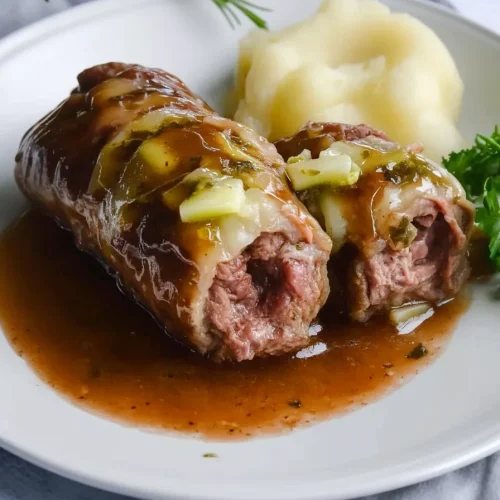
German Beef Rouladen Recipe
This German Beef Rouladen Recipe features thin beef rolls filled with mustard, bacon, onions, and dill pickles, then baked until tender and served with savory gravy.
Print
Pin
Servings: 4
Ingredients
- 8 slices beef top round roast sliced very thin
- 1/4 cup spicy brown German mustard
- 8 slices bacon
- 2 –3 dill pickles thinly sliced
- 1 small onion thinly sliced
- 1 tbsp butter
- 1 tbsp vegetable oil
- 1 1/4 cups low-sodium beef broth divided
- 1/4 cup dill pickle juice
- 2 tbsp cornstarch
- Salt and pepper to taste
- 2 –3 pinches sugar to taste, optional
Instructions
- Preheat the oven to 350°F.
- Arrange the thin slices of beef top round roast on a clean work surface.
- Spread each slice of beef with a thin, even layer of spicy brown German mustard.
- Place 1 slice of bacon on top of each mustard-coated beef slice.
- Add thinly sliced dill pickles and thinly sliced onion over the bacon, leaving the last few inches of each beef slice free of filling.
- Starting at the filled end, roll each beef slice tightly, tucking the pickles and onions inside as the beef is rolled.
- Secure each rolled beef piece with a toothpick.
- Repeat the process until all beef slices are filled, rolled, and secured.
- Heat the butter and vegetable oil in a large ovenproof skillet over medium heat.
- Add the beef rolls to the skillet.
- Brown the rouladen on all sides, turning carefully to maintain their shape.
- Once browned, add 1 cup low-sodium beef broth and the dill pickle juice to the skillet.
- Cover the skillet tightly with aluminum foil.
- Transfer the covered skillet to the preheated oven.
- Bake for 1 1/2 to 2 hours, or until the beef is fork-tender.
- Carefully remove the skillet from the oven.
- Transfer the rouladen to a plate and keep warm.
- Place the skillet with the cooking liquid on the stovetop over medium heat.
- Scrape the bottom of the skillet to loosen any browned bits.
- In a small bowl, whisk together the remaining 1/4 cup low-sodium beef broth and the cornstarch until smooth.
- Whisk the cornstarch mixture into the skillet.
- Cook, stirring frequently, until the gravy thickens.
- Season the gravy with salt and pepper to taste.
- Add 2–3 pinches of sugar, if desired, to balance the tanginess of the mustard and pickle juice.
- Return the rouladen to the skillet.
- Simmer gently until the beef rolls are warmed through.
- Spoon the gravy over the rouladen before serving.
- Remove toothpicks before serving.
- Serve warm with mashed potatoes, spaetzle, buttered noodles, red cabbage, or roasted vegetables.
Notes
To make this German Beef Rouladen Recipe gluten free, confirm that the beef broth, German mustard, bacon, dill pickles, and pickle juice are labeled gluten free.
Cornstarch is naturally gluten free, but it should be checked for gluten cross-contact if needed.
Use certified gluten-free bacon and mustard when preparing this recipe for someone with celiac disease or gluten sensitivity.
Avoid serving the rouladen with traditional wheat-based spaetzle or egg noodles unless using gluten-free versions.
Use clean cookware, utensils, cutting boards, and work surfaces to prevent gluten cross-contact.